The students in grade 7 at St. John Paul II School (JPII) had a special interest in the recent Artemis II space journey. As astronauts prepare for longer journeys into deep space, JPII students are playing a small but meaningful role in the future of space exploration, right from their classroom.
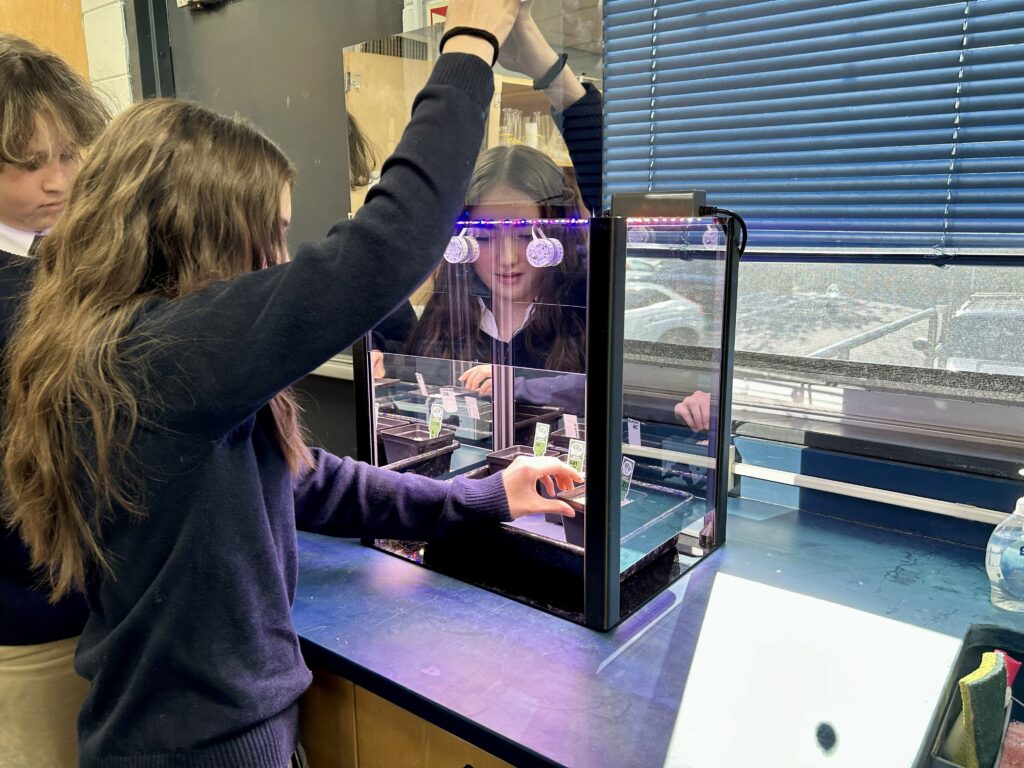
Using specialized plant habitats that mimic the Vegetable Production System (Veggie) aboard the International Space Station, students are conducting hands-on experiments to study plant growth in space-like conditions to help address the nutritional needs of astronauts on deep space missions. Their work is part of Growing Beyond Earth, a federally funded science program led by the Fairchild Tropical Botanic Garden in partnership with NASA.
JPII is proud to be one of 500 middle and high schools in the country and only one of three in the state of Massachusetts, taking part in this program. Through their research and participation, students collect and submit plant growth data to the Space Crop Production Team at NASA’s Kennedy Space Center.
“Through Growing Beyond Earth, JPII students are not only learning about plant biology—they are helping shape the future of human space travel. The opportunity to contribute to NASA scientific research from the classroom opens an entire universe to our students,” said Mrs. Meaghan Wile, science teacher at St. John Paul II School.
The experiments, designed in coordination with NASA’s Science Mission Directorate, allow students to test new plant varieties and growing techniques using hardware modeled after systems currently in place aboard the International Space Station. Their findings contribute to a growing body of research that supports one of the biggest challenges of deep space travel: developing sustainable food sources for long-duration missions.
“This program provides an extraordinary opportunity for students to engage in authentic scientific research,” said Paula Daly, Assistant Head of School at the Preparatory Division. “It empowers them to think creatively, ask meaningful questions, and see themselves as contributors to the future of science and exploration.”
So, the next time you enjoy a fresh salad, consider this: the research happening in classrooms like those at St. John Paul II School may one day help feed astronauts on missions far beyond our home planet with something freshly picked from Veggie.